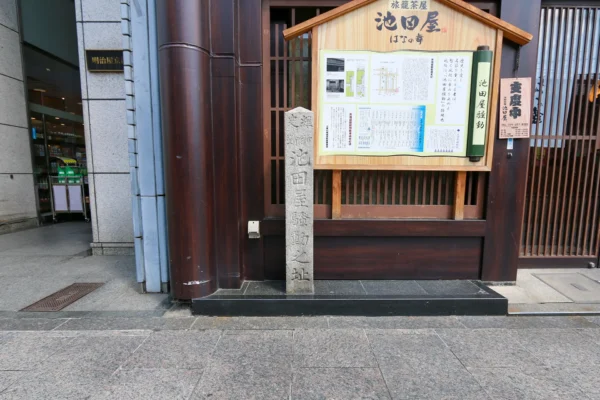
The Site of Yoshimura Torataro’s Temporary Residence is marked by a stone monument on Kiyamachi Street in central Kyoto. It commemorates the place where the Tosa-born imperial loyalist stayed during the turbulent final years of the Tokugawa shogunate.
Yoshimura left the Tosa Domain and devoted himself to the sonno joi movement, which called for restoring political authority to the emperor and resisting foreign influence. In 1863, he helped organize the Tenchugumi and launched an armed uprising in Yamato Province under the leadership of the court noble Nakayama Tadamitsu.
Although the surrounding area is now one of downtown Kyoto’s busiest entertainment districts, Kiyamachi was once lined with domain residences and temporary lodgings used by political activists. The monument preserves the memory of a young samurai whose life became closely associated with one of the earliest armed uprisings of the final years of the shogunate.
History
Yoshimura Torataro (1837–1863) was born in Tosa Province, in present-day Kochi Prefecture. Originally a village headman, he became increasingly committed to the imperial loyalist movement and joined the Tosa Loyalist Party led by Takechi Zuizan.
Yoshimura later left the Tosa Domain without permission and became active in Kyoto. After being arrested and returned to Tosa, he was eventually released and came back to the imperial capital.
In 1863, Yoshimura joined Fujimoto Tesseki, Matsumoto Keido, and other loyalists in organizing the Tenchugumi. With the young court noble Nakayama Tadamitsu as their commander, the group marched into Yamato Province and seized the magistrate’s office at Gojo.
Their uprising quickly lost political support following the coup of August 18, which removed radical imperial loyalists from influence in Kyoto. Pursued by forces loyal to the shogunate, the Tenchugumi collapsed after roughly 40 days of fighting, and Yoshimura was killed in the Yoshino region.
The monument marking his former lodging was erected by the Kyoto City Education Association in 1928.
Highlights
Home of a Tenchugumi Leader
The monument marks the temporary Kyoto residence of Yoshimura Torataro, one of the principal organizers of the Tenchugumi uprising.
Final Days Before the Uprising
Yoshimura stayed here in 1863, shortly before leaving Kyoto to launch an armed revolt in Yamato Province.
Bakumatsu History on Kiyamachi Street
During the late Edo period, the area contained domain residences, inns, and lodgings used by samurai activists from across Japan.
Monument Erected in 1928
The stone marker was installed by the Kyoto City Education Association and bears an inscription identifying Yoshimura’s former residence.
A Young Imperial Loyalist
Yoshimura died at the age of 27, but his leadership of the Tenchugumi made him a notable figure in the history of the Bakumatsu era.
Visit Tips
The monument stands near the entrance of a building on the east side of Kiyamachi Street and can be easy to overlook. Nearby markers commemorate the former residence of Takechi Zuizan and the birthplace of Western-style chirimen clothing.
This area is especially rewarding for visitors interested in Bakumatsu history. The Site of the Ikedaya Incident, the Former Residence of Sakuma Shozan, the monuments associated with Sakuma Shozan and Omura Masujiro, and Sanjo Bridge are all within walking distance.
Information
| Access |
|
|---|---|
| Address | 528 Kami-Osaka-cho, Kiyamachi-dori Sanjo-agaru, Nakagyo-ku, Kyoto 604-8001, Japan |