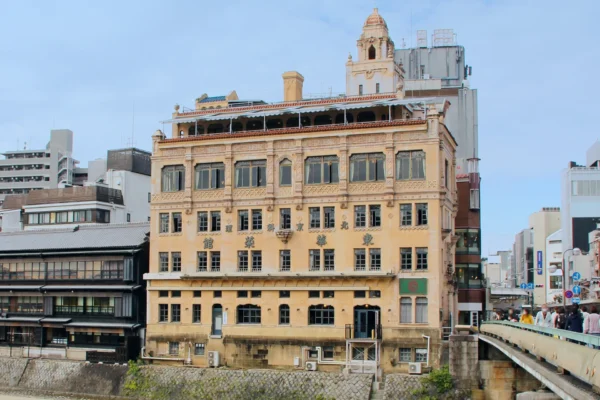
Minamiza Theatre is Japan’s oldest continuously operating Kabuki theatre and one of Kyoto’s most important examples of early modern theatre architecture. The present building was completed in 1929 and designed by Kyoto architect Naojiro Shiranamise.
Standing beside Shijo Bridge at the entrance to Gion, the theatre combines reinforced concrete construction with traditional Japanese architectural elements, creating a distinctive landmark that blends modern engineering with classical design. Today, Minamiza continues to host Kabuki performances and other traditional performing arts, preserving a theatrical tradition that dates back more than four centuries.
History
The origins of Minamiza date to 1603, when performances inspired by Izumo no Okuni, the founder of Kabuki, were staged along the dry riverbed of the Kamo River.
The current theatre was completed in 1929 under the design of Naojiro Shiranamise. While employing modern reinforced concrete construction, the architect incorporated traditional Japanese roofs, gables, and decorative details, producing a theatre that reflects both Kyoto’s heritage and the architectural advances of the early Showa period.
The building was designated a Registered Tangible Cultural Property in 1996 and later an Important Cultural Property of Japan in 1998. It remains the home of Kyoto’s famous annual Kaomise Kabuki Performances, held every December.
Highlights
highlights-en
Japan’s Historic Kabuki Theatre
With a history spanning more than 400 years, Minamiza remains one of Japan’s most celebrated venues for traditional Kabuki theatre.
Designed by Naojiro Shiranamise
Completed in 1929, the building combines reinforced concrete construction with elegant traditional Japanese architectural forms.
Traditional Exterior
Large tiled roofs, decorative gables, and wooden-style detailing create an appearance that harmonizes beautifully with Kyoto’s historic streetscape.
Kaomise Performances
Every December, the theatre hosts Kyoto’s famous Kaomise Kabuki season, announced by the iconic wooden actor signboards displayed across the façade.
Landmark at Gion
Standing beside Shijo Bridge and the Kamo River, Minamiza forms one of Kyoto’s most recognizable cityscapes and serves as the symbolic gateway to Gion.
Visit Tips
Even without attending a performance, the theatre’s impressive exterior is well worth visiting. If performances are scheduled, consider purchasing tickets in advance to experience one of Japan’s oldest living performing arts traditions.
The surrounding area—including Tohkasaikan, Restaurant KIKUSUI, Pontocho Alley, Gion Shirakawa, and Yasaka Shrine—offers one of Kyoto’s finest walking routes for visitors interested in both architecture and traditional culture.
Information
| Opening Hours |
|
|---|---|
| Admission |
|
| Access |
|
| Address | 198 Nakano-cho, Shijo-dori Yamatooji Nishi-iru, Higashiyama-ku, Kyoto, Japan |
| Website | https://www.shochiku.co.jp/play/theater/minamiza/ |